ABOUT GRIDSYNC
Built by curiosity.
Kept alive by racing.
GridSync was never planned as a company or even as one specific product. It grew out of racing, data, design, experiments and a habit of eventually building the thing I wished already existed.
I’m Kevin. Carpenter by trade, sim racer by obsession and golfer whenever the ball decides to cooperate.
Could I build that myself?

THE LEAGUE YEARS
Driving was only half the job.
Sim racing eventually became much more than turning laps. League organisation, race control, stewarding, results and Racing League Tools became part of the routine.
It gave me a different view of racing. Not only from behind the wheel, but from the other side of the timing screen, where somebody still has to deal with everything that happens after the chequered flag.
“We’ll just do it manually” is rarely a long term strategy.
Working with Racing League Tools eventually produced another experiment. I wanted to take real Formula 1 results and prepare them for the same graphics workflow I already knew from league racing.
That became the Looney F1 Tool.

THE ORIGINAL RATIX
Before RaTiX was software, it was a report.
RaTiX Score already existed in 2025. The core structure was surprisingly close to what still exists today.
RTR · EXP · RAC · AWA · PAC · QAC · STR
Race results were collected manually and passed through an AI assisted rating workflow. The result was an individual driver report covering pace, racecraft, awareness, qualifying, strategy and experience.
It worked.
It also meant feeding the system manually, producing a report, copying everything into place and then doing exactly the same thing for the next driver.
COPY. PASTE. REPEAT.
The concept worked. The workflow did not scale.

THE FIRST GRIDSYNC
The idea became too big.
The original GridSync was supposed to become a complete driver platform with RaTiX at its core.
Profiles, ratings, statistics, league systems, telemetry and several other ideas started gathering around it. At some point I was trying to build so much at once that I lost the overview of my own project.
It was simply too much for one person.
So GridSync went on ice.

THE VISUAL SIDE
Some ideas become code.
Others belong on the car.
Liveries had already become another part of sim racing for me. Not because I wanted to build a catalogue or follow a fixed style, but because sometimes an idea for a car simply appears and refuses to leave.
That is also the rule I still follow today: I never force a design. If the idea is not there, I leave it alone. Creativity has to arrive on its own. Trying to manufacture that moment usually produces exactly the kind of design I do not want.
That is why the cars can look completely different from one another. Some designs came from communities and teams, some from real events, some from national identities and some simply from a visual idea that suddenly made sense on a particular car.
The Cannabeez cars developed their own black, gold and green visual language. An iRaceDeck Porsche translated another project directly onto the bodywork. A Porsche inspired by my visit to the Omega European Masters in Crans Montana turned a real experience into a completely different kind of paint.
Then there were the national designs. Germany, Norway, Switzerland and Austria became race cars influenced by football shirts, federation colours, cultural details and the occasional idea that probably should not work on a GT car but somehow does.
Those projects gradually became more detailed too. Spec maps, matte and gloss areas, hidden references, small country details and sponsor placement became part of the process. The goal was never just to cover a template. The car had to look like the design belonged to it.
A good livery should feel intentional before anyone notices the details.
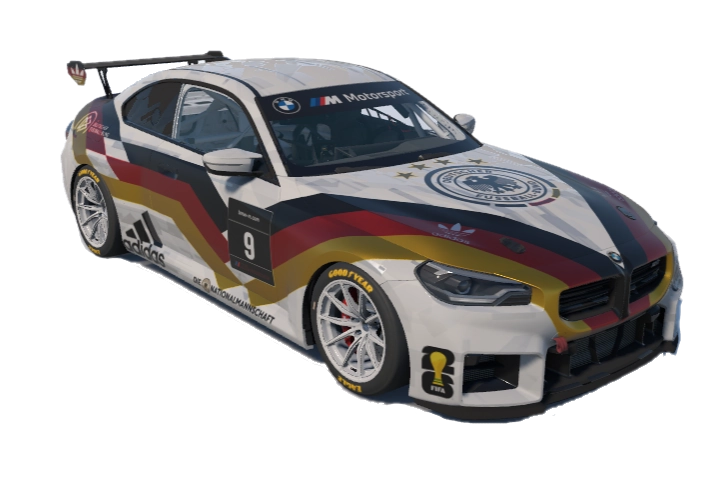
One of the clearest examples was the Germany World Cup BMW. I built it while the World Cup was actually happening, at a time when interest in national team liveries was unusually high. It was not planned around demand. The timing simply happened to be perfect.
Seeing more than one hundred drivers actually race one of my designs was different from simply seeing a screenshot receive attention. It meant the paint had left my own garage and became part of somebody else’s racing.
That is probably the part I enjoy most. A design starts as a spontaneous idea on my screen and, if everything lines up, eventually appears on cars driven by people I have never met.
THEN I READ A CHANGELOG
Seriously. That was it.
My sim racing focus had moved almost completely to iRacing when iRaceDeck introduced support for custom Race Engineer Voice Packs.
The feature existed. Nobody had released one yet.
I started discussing the idea with ChatGPT and we looked for a practical way to generate the amount of audio a complete Race Engineer actually needs.
Eventually we stumbled across Chatterbox.
AND THEN THINGS ESCALATED. quickly.
One experiment became several complete Voice Packs. Rendering turned into a repeatable workflow, releases became versioned and people actually started using them.
Somewhere along the way I ended up with the Voice Creator role in the iRaceDeck community.
I still make the packs for the same reason I started.
Because it is fun.
GRIDSYNC RETURNS
Discord was not the website.
Voice Packs needed somewhere permanent to live. Discord was great for discussion and community, but it was never meant to be the long term home for downloads, documentation and everything else that started appearing around the projects.
The old GridSync name was still there.
This time I did not try to revive the enormous all in one driver platform.
NOT ONE PRODUCT.
A HOME FOR THE PROJECTS.
Voice Packs, liveries, tools and experiments finally had somewhere to live.
And once GridSync was alive again, one old idea was very difficult to ignore.
FULL CIRCLE
The report became software.
Years earlier, RaTiX meant collecting race data manually, feeding it into a rating workflow and producing one driver report after another.
Now the goal was much simpler: keep the idea, lose the manual process.
2025 Race data → AI assisted report → copy and paste
TODAY iRacing → local processing → database → driver profile
Watching RaTiX capture and process a complete session through the local application for the first time felt different from finishing another website section or another tool.
The pipeline was working. Sessions were being captured, stored and turned into actual rating outputs.
That did not mean the rating model was finished. Calibration and validation of the six components became the next job.
The idea had survived the old reports, an abandoned version of GridSync and years of changing scope.
Now the software was doing the work itself.
That one meant something.
HOW I BUILD
Different material. Same process.
I’m a carpenter by profession, and I probably approach software more like a workshop than a laboratory.
My homemade sim rig is a pretty good example.
AutoCAD → DXF → CNC → wooden sim rig
It started as a digital drawing, became machine data and eventually came back out as something I could actually sit in.
Plan it. Build it. Test it. Improve it.
Software does not feel that different.
Today AI is another tool in that workshop. I use it heavily for planning, coding, debugging, testing and challenging ideas. The direction, decisions and the endless “no, that still looks wrong” loops remain mine.
RaTiX makes one boundary especially simple: AI can help build and test the system. It does not rate the driver.
OFF THE GRID
Apparently the data habit follows me.
When I am not racing or building something, there is golf.
Naturally, simply knowing the score was not enough either, so Arccos Caddie follows the rounds and turns every shot into more data to look at afterwards.
At some point the pattern becomes difficult to miss.
RAW INPUT IN.
USEFUL OUTPUT OUT.
AutoCAD → CNC
Formula 1 results → JSON
iRacing sessions → driver profiles
Golf shots → Arccos
Apparently I have a type.
GRIDSYNC TODAY
Still independent. Still evolving.
GridSync is now what it probably should have been from the beginning: a home for independent sim racing projects.
Voice Packs started with one changelog.
Liveries grow from ideas that are worth putting on a car.
Tools usually begin when repeating something manually gets annoying enough.
RaTiX is an old report that became working software and is now in rating validation.
GridSync is built independently, but never in isolation. Communities like iRaceDeck and Cannabeez are part of the environment around it, and seeing somebody else actually use something I built is much more interesting than leaving it on my own drive.
Most projects started because I wanted them myself.
Sharing them is the easy part.
WHAT NEXT?
GridSync is not finished.
Good.
The project has already changed direction once. Some ideas disappeared. Some came back better.
There will probably always be another race, another experiment and another moment where I ask:
Could I build that myself?
See you on the grid.
GRIDSYNC COMMUNITY
The next idea will probably start here.
Projects, releases, experiments and everything in between continue on Discord.
Join GridSync Discord →